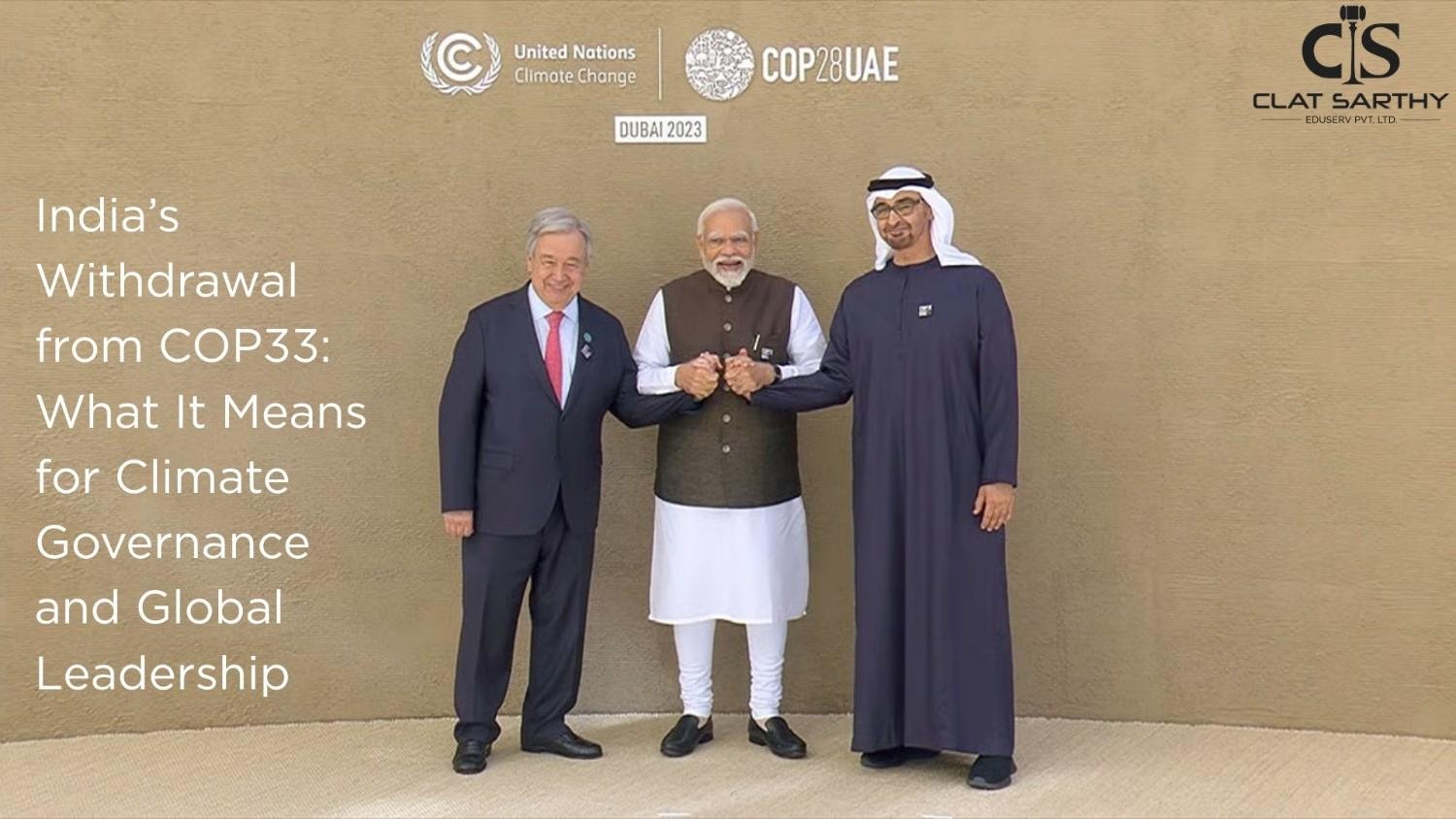
Can a country influence global climate negotiations without hosting a major international summit?
India’s withdrawal from hosting COP33 raises important questions about climate diplomacy, international law, and global leadership—all highly relevant for CLAT.
India has stepped back from hosting COP33 (2028) under the United Nations Framework Convention on Climate Change (UNFCCC).
This leaves South Korea as the only remaining candidate
The decision has sparked debate on India’s role in global climate governance
The United Nations Framework Convention on Climate Change (UNFCCC) is the primary global treaty addressing climate change.
Adopted at the Rio Earth Summit (1992)
Aims to stabilize greenhouse gas emissions
Provides a framework for international cooperation
Conference of the Parties (COP) is:
The highest decision-making body under UNFCCC
Held annually
Platform where countries negotiate:
Emission targets
Climate finance
Adaptation strategies
Accountability mechanisms
\text{CBDR-RC} = \text{Common but Differentiated Responsibilities and Respective Capabilities}
This principle means:
All countries must fight climate change
But responsibilities differ based on:
Historical emissions
Economic capacity
Kyoto Protocol (1997)
Legally binding emission reduction targets for developed nations
Paris Agreement (2015)
Global commitment to limit temperature rise
Flexible obligations for developing countries
India aims to balance development with sustainability:
Expansion of non-fossil fuel energy
Reduction in emissions intensity
Creation of carbon sinks (forests, plantations)
These reflect a development + environment balance strategy
Hosting a COP summit gives a country:
Greater negotiation power
Ability to influence:
Climate finance discussions
Adaptation policies
Loss and damage framework
Enhanced global leadership image
India may lose an opportunity to shape negotiations at COP33
The decision may reflect:
Focus on internal climate policies
Avoiding pressure for stricter commitments
India often represents Global South interests
Withdrawal may weaken collective bargaining power
Indicates a cautious approach toward global climate leadership
This development highlights a key global dilemma:
Balancing national interest
vs
Fulfilling global environmental responsibility
As climate negotiations become more complex, such decisions will shape the future of global cooperation.
This topic combines:
International Law
Environmental Law
Global Governance
Questions may test:
CBDR-RC principle
Treaty obligations
Role of international institutions
Possible comprehension topics:
Climate justice
Developed vs developing country responsibilities
Global negotiation frameworks
UNFCCC = Global climate treaty
COP = Decision-making forum
CBDR-RC = Core principle of climate law
India withdrew from hosting COP33
Impacts global leadership and negotiation power
Expected MCQ:
Which principle states that countries have different responsibilities based on capacity and historical emissions?
Answer: CBDR-RC
Possible Passage Question:
Analyze how India’s withdrawal from COP33 affects its role in global climate governance.
India’s withdrawal from COP33 is not just an administrative decision—it reflects deeper issues of climate justice, diplomacy, and global leadership, making it highly relevant for CLAT preparation.
For more CLAT-oriented current affairs and smart preparation strategies, stay connected with CLAT SARTHY.

Your Trusted Law Coaching Partner – Guiding You Towards a Brighter Future with Expert Mentorship and Proven Success Strategies.
Copyright 2025 © All Right Reserved