
The Right to Walk Judgment delivered by the Supreme Court of India in Maniyar Iliyaz @ Shaik Riyaz v. P. Ayyappan (2026) marks a landmark development in constitutional law and urban governance. In a significant ruling, the Court held that the right to safe and accessible footpaths is an integral part of Article 21 of the Constitution, placing pedestrians’ rights above unrestricted vehicular movement.
The Right to Walk Judgment is highly relevant for CLAT aspirants because it combines constitutional law, Directive Principles of State Policy, urban governance, environmental jurisprudence, and current affairs.
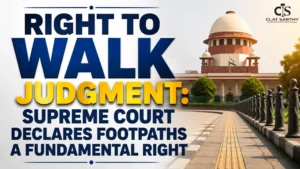
What Is the Right to Walk Judgment?
The Right to Walk Judgment is a landmark Supreme Court decision that recognizes walking as a constitutional right linked to the Right to Life under Article 21.
The Bench comprising Justice P.S. Narasimha and Justice Atul S. Chandurkar held that citizens have the right to safe, accessible, and obstruction-free footpaths. The Court also recommended that Parliament and State Governments enact a dedicated law and establish an independent regulator to protect pedestrian rights.
Background of the Right to Walk Judgment
The Right to Walk Judgment arose from concerns regarding the poor condition of footpaths, widespread encroachments, and the increasing prioritization of vehicles over pedestrians.
The Supreme Court observed that rapid urbanization had significantly reduced safe walking spaces, forcing pedestrians to walk on roads and exposing them to accidents and inconvenience.
According to the Court, public infrastructure should not be designed solely for motor vehicles but must equally serve pedestrians.
Why the Right to Walk Judgment Is Important
The Right to Walk Judgment expands the scope of Article 21 by recognizing safe pedestrian movement as an essential component of a dignified life.
The Court clarified that footpaths are not merely accident-prevention measures but public spaces that enable citizens to exercise their freedom of movement.
Walking, according to the judgment, is itself a constitutional value.
Key Observations in the Right to Walk Judgment
1. Footpaths Are a Fundamental Right
The Court held that footpaths exist to enable people to walk safely and freely, not merely to separate pedestrians from vehicles.
2. Walking Is a Constitutional Freedom
The Right to Walk Judgment recognized walking as an expression of personal liberty protected under Article 21.
3. Tragedy of the Commons
Borrowing from environmental law, the Court applied the concept of the “Tragedy of the Commons” to footpaths.
It observed that:
- Illegal encroachments
- Garbage dumping
- Poor maintenance
- Unregulated occupation
have collectively reduced public access to pedestrian infrastructure.
4. Historical Importance of Walking
The Court highlighted that walking has historically represented:
- Freedom
- Peaceful protest
- Political participation
- Social equality
- Public engagement
Thus, protecting walkable spaces also strengthens democratic values.
Right to Walk Judgment and Article 21
One of the most significant aspects of the Right to Walk Judgment is its interpretation of Article 21 of the Constitution of India.
The Court held that the Right to Life includes:
- Safe mobility
- Human dignity
- Accessible public infrastructure
- Freedom of movement
This judgment continues the Supreme Court’s tradition of expanding Article 21 through judicial interpretation.
Right to Walk Judgment and Article 39(b)
The Right to Walk Judgment also relied upon Article 39(b) of the Directive Principles of State Policy.
Article 39(b) requires that material resources of the community be distributed to serve the common good.
The Court treated road space as a public resource and held that it cannot be allocated exclusively for motor vehicles while ignoring pedestrians.
Responsibilities of Local Authorities
The Right to Walk Judgment identified several public authorities responsible for protecting pedestrian rights.
These include:
- Municipal Corporations
- Municipal Councils
- Panchayats
- Urban Development Authorities
The Court described these institutions as trustees responsible for maintaining safe and accessible footpaths.
Need for a New Law on Pedestrian Rights
The Supreme Court observed that the Motor Vehicles Act, 1988 primarily focuses on regulating vehicular movement and provides limited protection for pedestrians.
To address this gap, the Court recommended:
- A dedicated Right to Walk law
- A statutory regulatory authority
- Stronger enforcement mechanisms
- Uniform standards for pedestrian infrastructure
The Court cited the Right to Education Act, 2009 as an example of how legislation can effectively implement constitutional rights.
Constitutional Significance of the Right to Walk Judgment
The Right to Walk Judgment is constitutionally significant because it strengthens several constitutional principles.
Important Constitutional Provisions
- Article 21 – Right to Life and Personal Liberty
- Article 19(1)(d) – Freedom of Movement
- Article 39(b) – Distribution of Community Resources
- Rule of Law
- Social Justice
The judgment demonstrates how constitutional rights evolve to meet modern urban challenges.
Why the Right to Walk Judgment Matters for CLAT Aspirants
For students preparing at CLATSARTHY, the Right to Walk Judgment is highly important.
Topics Covered
- Article 21
- Directive Principles of State Policy
- Constitutional Law
- Urban Governance
- Public Policy
- Environmental Jurisprudence
- Current Affairs
Questions may be framed around judicial interpretation, pedestrian rights, Article 21 expansion, and constitutional governance.
Conclusion
The Right to Walk Judgment represents a transformative step in Indian constitutional law. By recognizing safe footpaths as a constitutional right, the Supreme Court has shifted the focus of urban planning from vehicle-centric development to citizen-centric development.
The judgment reinforces that roads are public resources meant for everyone—not just vehicles. For CLAT aspirants, the Right to Walk Judgment is an excellent example of how constitutional values, judicial innovation, and public policy work together to strengthen fundamental rights.

Great content! Keep up the good work!