
International Criminal Court (ICC)
The International Criminal Court (ICC) is facing renewed pressure following measures taken by the United States against the Court, including sanctions on ICC officials and efforts to encourage countries to withdraw from the Rome Statute. Venezuela and Chad have also announced plans to leave the Rome Statute. These developments have once again raised questions about […]
BRICS 2026: India’s Leadership and Strategic Importance
Why in News? India hosted the 18th BRICS Summit in New Delhi on 12–13 September 2026 under its BRICS Chairship. India’s theme for 2026 was: “Building for Resilience, Innovation, Cooperation and Sustainability.” The summit is important for CLAT 2027 because it connects with International Relations, Global South, India’s foreign policy, multilateralism and global governance. What […]
The Places of Worship Act, 1991: Statutory Intent, Constitutional Friction, and Recent Judicial Developments
The Places of Worship (Special Provisions) Act, 1991 is an important legislation dealing with the religious character of places of worship in India. Enacted against the backdrop of the Ram Janmabhoomi movement during the 1990s, the Act sought to preserve social order, uphold secularism, and provide legal finality regarding the religious character of places of […]
THE RIGHT TO PROTEST VS. POLICE POWERS: ARTICLE 19, BNS & BNSS EXPLAINED FOR CLAT 2027 UG
Introduction The recent protests at Jantar Mantar during the “Chalo Sansad” rally demanding reforms in the National Testing Agency (NTA) have once again raised an important constitutional question: How far does the right to protest extend, and when can the police lawfully intervene? For CLAT 2027 UG aspirants, this issue is highly relevant because it […]
Understanding Article 142: The Supreme Court’s Power to Do Complete Justice
Introduction The Supreme Court of India is the guardian of the Constitution and the highest judicial authority in the country. While most courts are required to strictly follow statutory law, the Supreme Court possesses a unique constitutional power that allows it to ensure justice even in exceptional situations where existing laws may fall short. This […]
Custodial Trial Explained: Is Keeping an Accused in Jail Throughout the Trial Legal?
Introduction The concept of a Custodial Trial has recently become a significant topic in Indian criminal law. Although investigating agencies often request courts to keep an accused person in judicial custody throughout the trial, an important legal question arises: Does Indian law actually permit a custodial trial? The debate surrounding Custodial Trial has gained attention […]
Article 326 and Article 19(1)(a): Understanding Voting Rights in India for CLAT Aspirants
Article 326 and Article 19(1)(a) together form the constitutional foundation of voting rights in India. While Article 326 establishes who has the right to vote through the principle of universal adult suffrage, Article 19(1)(a) protects how citizens exercise that choice by guaranteeing freedom of speech and expression. Through a series of landmark judgments, the Supreme […]
Right to Walk Judgment: Supreme Court Declares Footpaths a Fundamental Right
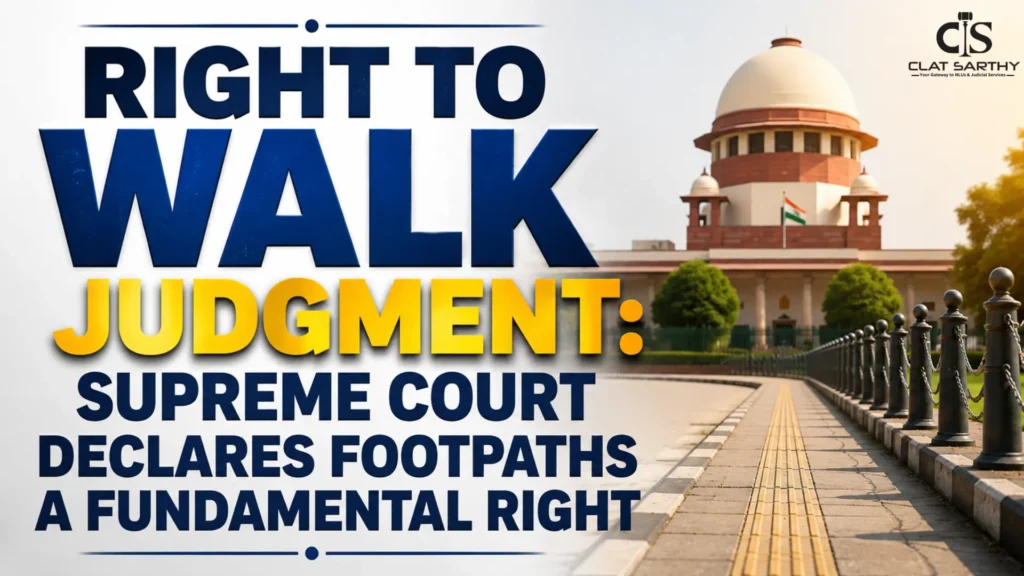
The Right to Walk Judgment delivered by the Supreme Court of India in Maniyar Iliyaz @ Shaik Riyaz v. P. Ayyappan (2026) marks a landmark development in constitutional law and urban governance. In a significant ruling, the Court held that the right to safe and accessible footpaths is an integral part of Article 21 of […]
Loss of Domestic Care Compensation: Supreme Court Recognises Homemakers as Nation Builders
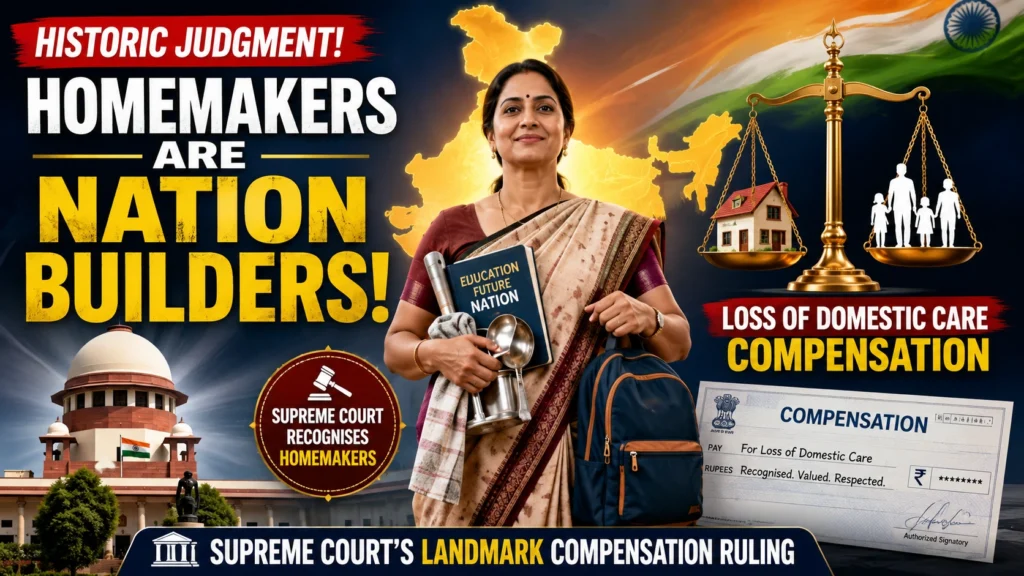
Introduction The concept of Loss of Domestic Care Compensation has received historic recognition from the Supreme Court of India in a landmark judgment concerning compensation for the death of homemakers in road accidents. In a significant step toward gender justice and economic recognition of unpaid labour, the Court held that homemakers are “nation builders” and […]
Indian Tort Law: Future Prospects, Present Challenges
Introduction Indian Tort Law remains one of the most important yet underdeveloped areas of the Indian legal system. Unlike criminal law, which focuses on punishing offenders on behalf of the State, tort law is primarily concerned with compensating victims who suffer harm due to civil wrongs. It acts as a mechanism for accountability, deterrence, and […]