
The doctrine of the Separation of Powers has recently gained attention after the Supreme Court of India declined a proposed meeting with the Joint Parliamentary Committee (JPC) examining the Constitution (129th Amendment) Bill, 2024, which seeks to implement the concept of One Nation, One Election. The proposed interaction was called off amid concerns raised by members of the judiciary and opposition representatives regarding judicial independence, the separation of powers, and the possibility of future judicial review of the proposed legislation. This development highlights the importance of maintaining a clear constitutional boundary between the Legislature and the Judiciary.
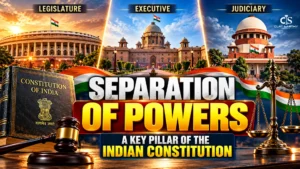
What Is the Doctrine of Separation of Powers?
The doctrine of Separation of Powers is a constitutional principle associated with the French philosopher Montesquieu, who explained it in his influential work The Spirit of the Laws. The doctrine advocates the division of governmental authority among three branches: the Legislature, which makes laws; the Executive, which implements laws and administers the country; and the Judiciary, which interprets laws and delivers justice. The primary objective is to prevent the concentration of power in a single institution, minimise the possibility of authoritarian rule, and protect the rights and liberties of citizens.
Separation of Powers in the Indian Constitution
Unlike the United States, where the separation of powers is comparatively rigid, India follows a system of functional separation combined with checks and balances. The three organs of government perform distinct functions while maintaining certain constitutional overlaps to ensure accountability. Article 50 of the Indian Constitution, a Directive Principle of State Policy (DPSP), directs the State to separate the judiciary from the executive in public services. Articles 121 and 211 restrict discussions in Parliament and State Legislatures concerning the conduct of Supreme Court and High Court judges in the discharge of their duties, subject to constitutionally prescribed exceptions. Similarly, Articles 122 and 212 protect legislative proceedings from judicial scrutiny on the ground of procedural irregularities, without excluding review on all constitutional grounds.
The Supreme Court has also recognised the separation of powers as an essential feature of the Constitution. In landmark judgments such as Kesavananda Bharati v. State of Kerala (1973) and Indira Nehru Gandhi v. Raj Narain (1975), the Court strengthened the principle that Parliament’s power to amend the Constitution is not unlimited. The Basic Structure Doctrine prevents Parliament from altering the Constitution’s fundamental features, among which the separation of powers and judicial independence hold an important place.
Why Is the Proposed Meeting a Matter of Concern?
One of the principal concerns relates to the possibility of pre-adjudication and judicial bias. The Legislature is responsible for framing and enacting laws, whereas the Judiciary has the constitutional responsibility to interpret those laws and examine their validity through judicial review. Article 13 provides the constitutional basis for reviewing laws that violate Fundamental Rights. If sitting judges participate in discussions or offer advice on a proposed bill, questions may arise about their impartiality if the legislation is subsequently challenged before them. Even if no actual bias exists, such participation could create a perception of a conflict of interest.
Another concern is the potential erosion of judicial independence. Public confidence in the judiciary depends on the belief that judges decide cases independently, without political influence or institutional pressure. Meetings between sitting judges and parliamentary committees dominated by political representatives may create an impression that the Judiciary is aligned with a particular legislative agenda. Preserving institutional independence is therefore essential for maintaining the credibility and impartiality of the justice system.
The proposed interaction also raises questions about established constitutional mechanisms. Under Article 143, the President of India may refer questions of law or fact of public importance to the Supreme Court for its advisory opinion. This provides a formal constitutional route for seeking the Court’s views on significant legal questions. However, Article 143 is an advisory mechanism exercised through a Presidential reference; it is not a general requirement that every proposed law must be referred to the Supreme Court. The concern is whether informal consultations on proposed legislation could blur the distinction between the judicial and legislative functions.
Furthermore, involving judges in the drafting or examination of legislation may blur institutional boundaries. Although the Indian Constitution does not prescribe a completely rigid separation of powers, each organ must operate within its constitutional limits. If judges become involved in shaping a bill, they could be perceived as contributing to legislation whose validity they might later be required to determine. Maintaining a clear distinction between law-making and judicial review helps prevent institutional overreach and protects the legitimacy of constitutional governance.
Conclusion
The controversy surrounding the proposed meeting between the Supreme Court and the Joint Parliamentary Committee highlights the continuing relevance of the doctrine of Separation of Powers in India. The principle does not require complete isolation among the three organs of government; rather, it demands a careful balance between cooperation and institutional independence. While consultation and dialogue may be valuable in a constitutional democracy, they must not compromise judicial impartiality or blur the boundaries between law-making and adjudication. Ultimately, the Separation of Powers, supported by checks and balances and the Basic Structure Doctrine, remains essential to safeguarding constitutional supremacy, democratic accountability, and the rule of law.
CLAT Exam Takeaway
For CLAT aspirants, this topic is important for both Current Affairs and Legal Reasoning. Focus on Montesquieu’s theory, the distinction between separation of powers and checks and balances, Articles 13, 50, 121, 122, 143, 211 and 212, and the landmark judgments in Kesavananda Bharati v. State of Kerala (1973) and Indira Nehru Gandhi v. Raj Narain(1975). Understanding how constitutional principles apply to contemporary developments will help students connect current affairs with foundational legal concepts.
#CLATSARTHY #CLAT2027 #CLATPreparation #CLATAspirants #CLATCurrentAffairs #CLATLegalReasoning #CLATGK #CLATExam #CLATCoaching #CurrentAffairs2026 #IndianConstitution #SeparationOfPowers #SupremeCourtOfIndia #ConstitutionalLaw #LegalAwareness #LawEntranceExam #NLUAdmissions #LawAspirants #CLATStrategy #CLATUpdates