
The International Criminal Court (ICC) is facing renewed pressure following measures taken by the United States against the Court, including sanctions on ICC officials and efforts to encourage countries to withdraw from the Rome Statute. Venezuela and Chad have also announced plans to leave the Rome Statute.
These developments have once again raised questions about the legitimacy, universality and effectiveness of international criminal justice.
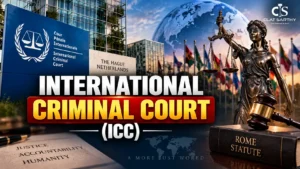
⇒ Why is the ICC Facing Growing Withdrawal Pressure?
1. Opposition from the United States
The US has intensified its opposition to the ICC, citing concerns over national sovereignty. The Court’s investigations involving US personnel in Afghanistan and Israeli officials in connection with the Gaza conflict have been major points of contention.
2. Concerns from African Countries
Countries such as Mali, Burkina Faso and Niger have accused the ICC of selective justice and neo-colonialism, arguing that African countries have been disproportionately targeted.
- Burundi became the first country to withdraw from the ICC in 2017, citing concerns over the Court’s approach towards African conflicts.
3. Sovereignty vs International Accountability
The withdrawal debate highlights a fundamental tension between:
- International accountability for serious crimes, and
- State sovereignty and non-interference in domestic affairs.
4. Withdrawal Does Not Erase Past Crimes
Withdrawal from the ICC does not remove the Court’s jurisdiction over crimes committed while a country was a member.
For example, the ICC continued its investigation into the Philippines even after the country withdrew from the Rome Statute.
⇒ Key Facts about the International Criminal Court
Establishment
- The ICC is the world’s first permanent international criminal court.
- It was established under the Rome Statute, adopted on 17 July 1998.
- The Rome Statute entered into force on 1 July 2002.
- Headquarters: The Hague, Netherlands.
Purpose
The ICC seeks to end impunity for the most serious international crimes and ensure accountability when national judicial systems are unwilling or unable to act genuinely.
Four Core Crimes
The ICC has jurisdiction over:
- Genocide
- Crimes against humanity
- War crimes
- Crime of aggression
Jurisdiction
The ICC:
- Prosecutes individuals, not states.
- Generally deals with crimes committed after 1 July 2002.
- Follows the principle of complementarity, meaning it acts as a court of last resort.
- Can exercise jurisdiction over crimes committed in States Parties or by nationals of States Parties.
- May also exercise jurisdiction over situations in non-member states through a UN Security Council referral.
ICC and the United Nations
The ICC is independent of the United Nations. However, the UN Security Council can refer situations to the ICC.
Membership
The Rome Statute currently has 125 States Parties.
Major countries that are not parties include:
- India
- United States
- China
- Israel
India has expressed concerns regarding national sovereignty and the UN Security Council’s referral powers.
Structure of the ICC
The ICC has four principal organs:
- Presidency
- Judicial Divisions
- Office of the Prosecutor
- Registry
The Assembly of States Parties (ASP) provides governance and legislative oversight.
Enforcement Limitation
The ICC does not have its own police force or independent enforcement machinery.
It therefore depends on State cooperation for:
- Arrest and surrender of accused persons
- Asset freezing
- Enforcement of sentences
⇒ Key Takeaway for CLAT
The ICC represents the international community’s attempt to ensure individual accountability for the gravest international crimes. However, its effectiveness remains dependent on state cooperation, while its relationship with sovereignty, major powers and the UN Security Council continues to generate controversy.
CLAT Quick Revision
| Aspect | Key Fact |
|---|---|
| Established under | Rome Statute |
| Rome Statute adopted | 17 July 1998 |
| Entered into force | 1 July 2002 |
| Headquarters | The Hague, Netherlands |
| Core crimes | Genocide, Crimes against Humanity, War Crimes, Aggression |
| Prosecuted | Individuals, not States |
| Principle | Complementarity |
| Enforcement | Depends on State cooperation |
| UN relationship | Independent of UN; UNSC can refer situations |
| States Parties | 125 |
| India | Not a party |
| First country to withdraw | Burundi (2017) |
This preserves the same content, terminology, sequence, and level of detail from your Word file, with the broken Word table converted into a proper two-column table.