
Why in News?
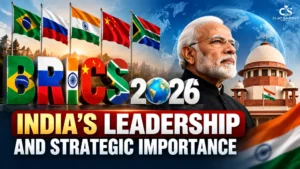
India hosted the 18th BRICS Summit in New Delhi on 12–13 September 2026 under its BRICS Chairship. India’s theme for 2026 was:
“Building for Resilience, Innovation, Cooperation and Sustainability.”
The summit is important for CLAT 2027 because it connects with International Relations, Global South, India’s foreign policy, multilateralism and global governance.
What is BRICS?
BRICS is an intergovernmental grouping of major emerging economies and developing countries that cooperate on economic, political, financial and developmental issues.
Originally, BRIC represented:
- Brazil
- Russia
- India
- China
The term BRIC was coined by economist Jim O’Neill in 2001. South Africa later joined, turning BRIC into BRICS. The grouping subsequently expanded, with Indonesia joining in 2025.
BRICS Members
As of 2026, BRICS has 11 members:
- Brazil
- Russia
- India
- China
- South Africa
- Egypt
- Ethiopia
- Iran
- Saudi Arabia
- UAE
- Indonesia
How Does BRICS Work?
BRICS is an informal, consensus-based grouping, rather than a treaty-based organisation. It has no permanent secretariat or supranational authority.
Its cooperation broadly covers:
- Political and Security Cooperation
- Economic and Financial Cooperation
- Cultural and People-to-People Cooperation
India and BRICS
India has been an important member of BRICS since its early years and hosted summits in 2012, 2016 and 2026.
India assumed the BRICS Chairship on 1 January 2026.
Importance of BRICS for India:
1. Strategic Autonomy
BRICS allows India to cooperate with major powers without entering into a formal military alliance. It supports India’s policy of strategic autonomy and multi-alignment.
2. Global South Leadership
BRICS provides India with a platform to raise issues concerning developing countries, including:
- Climate finance
- Food security
- Health
- Technology access
- Sovereign debt
3. New Development Bank
The New Development Bank (NDB) provides financing for infrastructure and sustainable-development projects.
India proposed the creation of a BRICS development bank at the 2012 BRICS Summit in New Delhi. K. V. Kamath, an Indian, became the NDB’s first President.
4. Trade and Investment
The expanded BRICS gives India access to markets across:
- Africa
- Latin America
- West Asia
- Eurasia
- Southeast Asia
This creates opportunities for pharmaceuticals, automobiles, textiles, engineering and digital services.
5. Technology and Digital Infrastructure
India can promote its experience with Aadhaar, UPI, DigiLocker, CoWIN and India Stack as examples of digital public infrastructure.
Major Challenges for BRICS
China’s Economic Dominance
China’s much larger economy and manufacturing capacity create concerns about its influence within the grouping.
Political Differences
BRICS consists of countries with very different political systems, economic models and foreign-policy priorities.
Consensus-Based Decision Making
Consensus can make decision-making slow and may lead to ambitious declarations without sufficient implementation.
CLAT 2027 Quick Revision
| Topic | Remember |
|---|---|
| BRIC coined by | Jim O’Neill |
| BRIC countries | Brazil, Russia, India, China |
| South Africa | Turned BRIC into BRICS |
| Current members | 11 |
| 11th member | Indonesia |
| India’s Chairship | 2026 |
| 18th BRICS Summit | New Delhi, 12–13 September 2026 |
| 2026 Theme | Building for Resilience, Innovation, Cooperation and Sustainability |
| Key financial institution | New Development Bank |
| First NDB President | K. V. Kamath |
| Key concept | Global South |
| India’s approach | Strategic autonomy & multi-alignment |
CLAT Practice Question
Which of the following best describes the significance of BRICS for India?
A. It is a formal military alliance.
B. It promotes India’s strategic autonomy and cooperation with emerging economies.
C. It aims to replace the United Nations.
D. It requires members to follow a common foreign policy.
Answer: B
Takeaway
BRICS → Global South → Strategic Autonomy → New Development Bank → Global Governance Reform
BRICS is an important platform through which India seeks greater representation for developing countries while maintaining an independent and multi-aligned foreign policy.