
Introduction
The Ignite Engine India innovation is transforming the future of the Indian space sector. Developed by Agnikul Cosmos, this advanced rocket engine represents a major breakthrough in space innovation in India.
With the rise of private space startups, India is moving towards faster, cheaper, and more efficient space missions. The Ignite Engine is a perfect example of how modern engineering is redefining space technology in India.
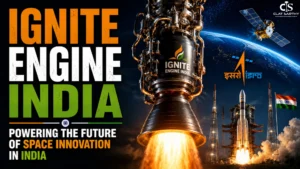
What is Ignite Engine India?
The Ignite Engine India is a semi-cryogenic rocket engine designed for small satellite launch vehicles. It is one of the most advanced examples of rocket technology in India.
What makes the Ignite Engine unique is that it is fully 3D printed using additive manufacturing technology. Unlike traditional engines, it is built as a single-piece structure, which improves reliability and reduces manufacturing time.
Key Features of Ignite Engine India:
- Fully 3D printed rocket engine
- Single-piece design for higher strength
- Manufactured within one week
- Reduced mechanical failure risks
This innovation places Ignite Engine India at the forefront of space innovation in India.
How 3D Printing is Revolutionizing Space Innovation in India
The use of 3D printing in the Ignite Engine India is a major advancement in aerospace engineering.
Benefits of 3D Printing:
- Fewer components and joints
- Higher durability and strength
- Faster production cycle
- Lower manufacturing cost
This technology is making space innovation in India more scalable and efficient.
Propellant and Material Used in Ignite Engine India
The Ignite Engine India uses:
- Liquid Oxygen (LOX)
- Kerosene
This combination makes it more practical than fully cryogenic engines, as it does not require extremely low temperatures.
The engine is built using Inconel, a high-performance alloy known for:
- Heat resistance
- High strength
- Durability under pressure
These features make Ignite Engine India highly reliable for modern space missions.
Electrically Driven Pump Technology
Another major innovation in Ignite Engine India is its electrically driven pump system.
Advantages:
- Better fuel control
- Higher efficiency
- Improved launch precision
This enhances the overall performance and reliability of rocket launches.
Agnibaan Rocket and Launch System
The Ignite Engine India powers the Agnibaan rocket, a small satellite launch vehicle developed by Agnikul Cosmos.
Key Capabilities:
- Payload capacity: up to 100 kg
- Designed for Low Earth Orbit (LEO)
- Supports on-demand launches
This makes space missions faster, flexible, and cost-effective.
Agnikul Cosmos and India’s Private Space Growth
Founded in 2017 at IIT Madras, Agnikul Cosmos is leading the private space revolution.
The company has also built India’s first private launchpad, located at the Satish Dhawan Space Centre.
Their successful 2024 mission proved the real-world capability of Ignite Engine India.
Why Ignite Engine India is Important for CLAT Aspirants
For students preparing at CLATSARTHY, Ignite Engine India is an important current affairs topic.
Benefits for Students:
- Covers science and technology GK
- Helps in current affairs preparation
- Improves analytical understanding
Understanding space innovation in India gives students an edge in competitive exams like CLAT.
Future of Space Innovation in India
The success of Ignite Engine India highlights the future of the Indian space sector.
Future Trends:
- Growth of private space startups
- Cost-effective launch systems
- Faster satellite deployment
- Advanced manufacturing technologies
India is becoming a global leader in space innovation.
Conclusion
The Ignite Engine India is not just a technological achievement—it represents the future of space innovation in India. With advanced engineering, 3D printing, and efficient propulsion systems, India is setting new benchmarks in the global space industry.
For students and aspirants, staying updated with such innovations is essential for success in exams and beyond.